Chapter 03
Tasks & quadrants
Capture what each role asks of you, then sort it by two honest questions: is it important, and is it urgent? The four answers get four very different treatments.
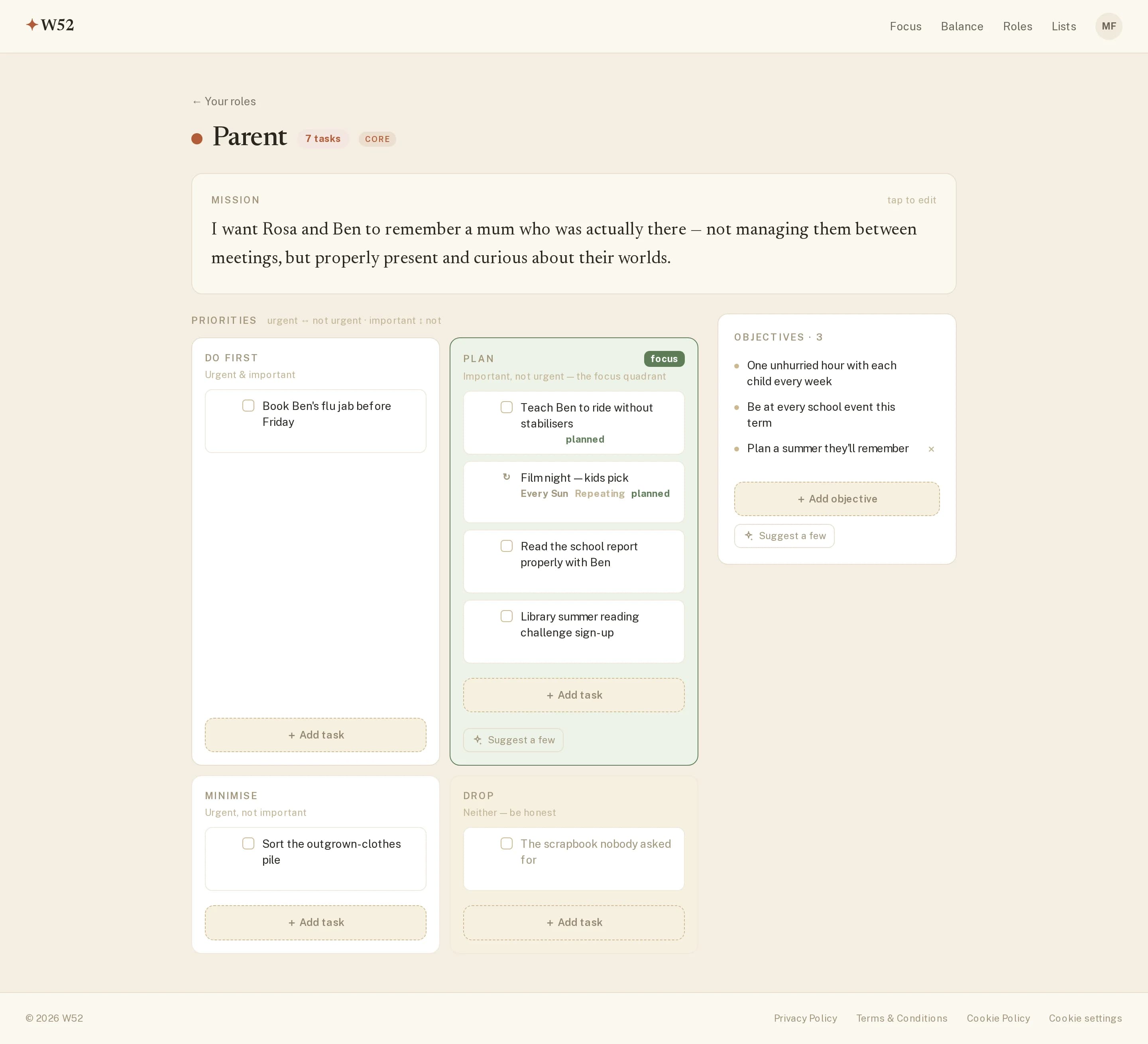
Tasks in W52 belong to a role, and every task lives in one of four quadrants — the classic importance-by-urgency grid. The sorting takes seconds and changes everything downstream, because each quadrant is handled differently:
- Do First — urgent and important. The signed form due Friday, the invoice that’s overdue. These flow straight onto your week, marked urgent.
- Plan — important, not urgent. The proposal that grows the business, the long run, teaching Ben to ride. Nothing forces these, which is exactly why they need protecting — this is the quadrant the whole method exists to serve.
- Minimise — urgent, not important. The inbox, the admin, the errands that shout. Do them small, batch them, don’t let them wear a whole evening.
- Drop — neither. Named and kept visible on purpose: writing down what you’re not doing is how it stops nagging you.
The order inside a quadrant is yours too — drag tasks up and down so the one that matters most sits at the top when planning comes around.
Why Plan gets the spotlight
Urgent things take care of themselves — they have deadlines and other people attached. The important-but-not-urgent work is the only kind that quietly doesn’t happen: nobody chases you to plan your daughter’s birthday or build the habit that gets you to a start line. W52 tilts the whole product toward this quadrant: it’s tinted, it’s counted, and it’s what the weekly planner pulls from first.
Linking tasks to objectives
A task can point at one of its role’s objectives. It’s optional, but it closes a loop: the objective says sign two retainers by autumn, the task says write the Coastline proposal, and the week you complete it, the objective moved. Tasks that link to nothing are worth a second look — sometimes they’re maintenance, sometimes they’re drift.
Repeats
Some commitments aren’t one-offs — the Saturday long run, Sunday film night. Any task can repeat daily, weekly or monthly; each occurrence lands on the right day of the right week by itself, and counts as one commitment, not many.
Sorted work is only potential. The point of it all is the ritual in the next chapter: the weekly plan.