Chapter 01
Roles
Before tasks, before plans, before anything with a checkbox: the handful of hats you actually wear. Roles are the foundation the whole method stands on.
Most tools start with a list of things to do. W52 starts with a different question: who are you trying to be? The answer is rarely one thing. You’re a parent and a partner; you run a business and a body; you have friends who’d like to see you occasionally. Each of those is a role, and each one quietly asks something of your week.
Write them down and something useful happens: the vague feeling of “too much going on” becomes five or six named things you can actually look at. That’s the whole trick. A week can be planned across five roles; it can’t be planned across a fog.
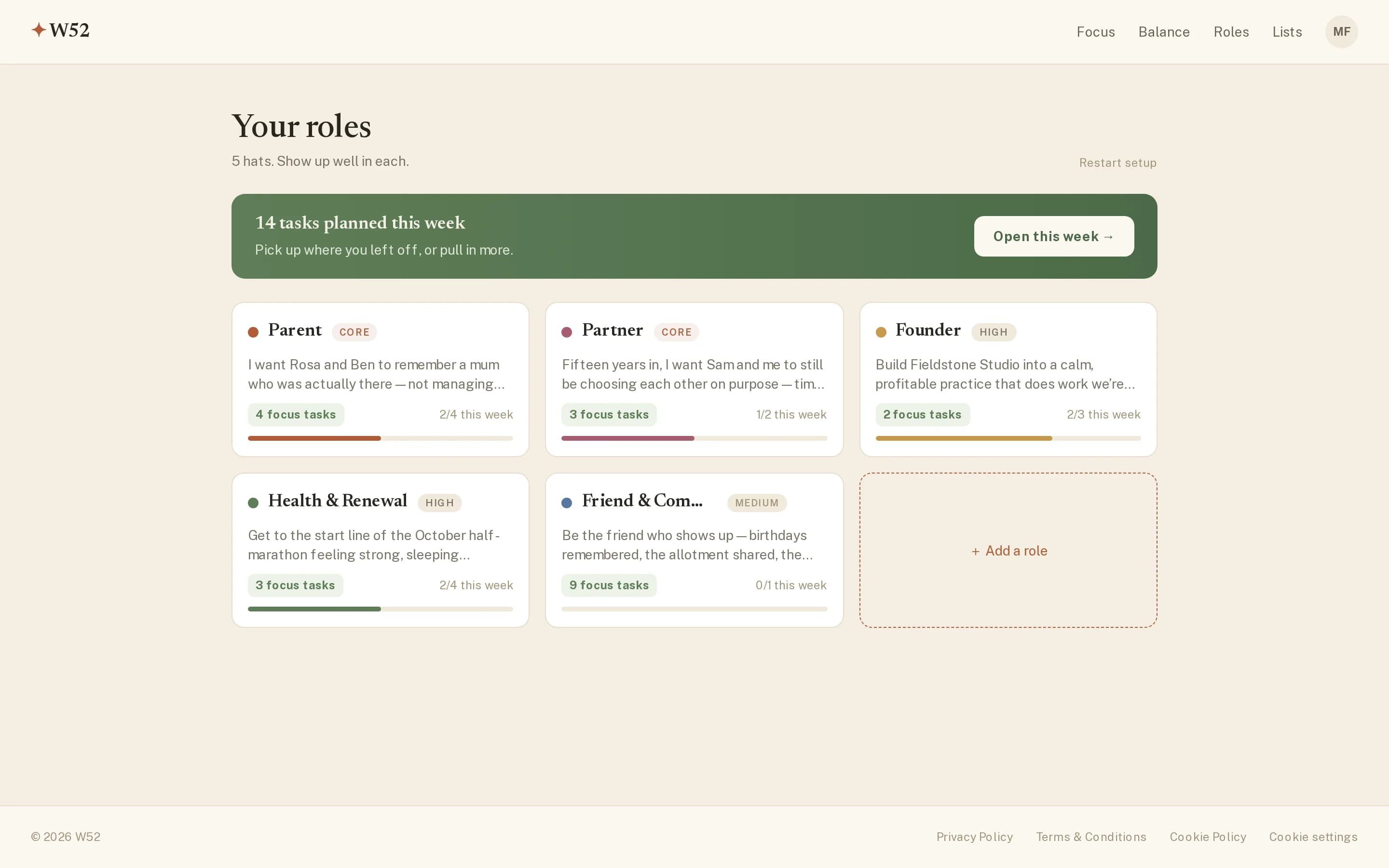
Naming your roles
Aim for four to six. Fewer and the picture is too coarse to plan with; many more and no week can honour them all. Some starting points:
- Use your own words. “Dad”, “Co-founder”, “Allotment keeper” — whatever you’d actually say out loud.
- Include a role for yourself. Health, rest, renewal — whatever you call it, the role that maintains the person playing all the others. It’s the easiest one to skip and the most expensive one to lose.
- Don’t split hairs. If two roles always want the same hours from you, they’re probably one role.
Importance, and what it changes
Each role carries a weight — Core, High, Medium or Low. This isn’t a ranking of love; it’s an honest note about what this stretch of life is asking. W52 uses it when it reads your week’s balance: a quiet week in a Core role is worth noticing; a quiet week in a Low role is just a quiet week.
Colour carries through everything
Every role gets a colour, and that colour follows its tasks everywhere — the weekly plan, the Focus screen, the balance bars, the year view. After a week or two you can read a screen’s colour mix at a glance: a wall of one hue is a week that belongs to one role, whether or not you meant it to.
Once your roles exist, each one needs a direction to point in. That’s the next chapter: missions and objectives.