Chapter 06
Lists
Not everything you need to remember deserves a place in your week. Lists hold the rest — errands, books, ideas — close at hand and out of the way.
The method is strict about the week: role work, chosen on Monday, in believable amounts. Lists are the release valve that makes that strictness liveable. The MOT reminder, the book a friend mentioned, present ideas collected in March for a birthday in June — none of it is a role, none of it belongs on the plan, and all of it needs to go somewhere the moment it occurs to you.
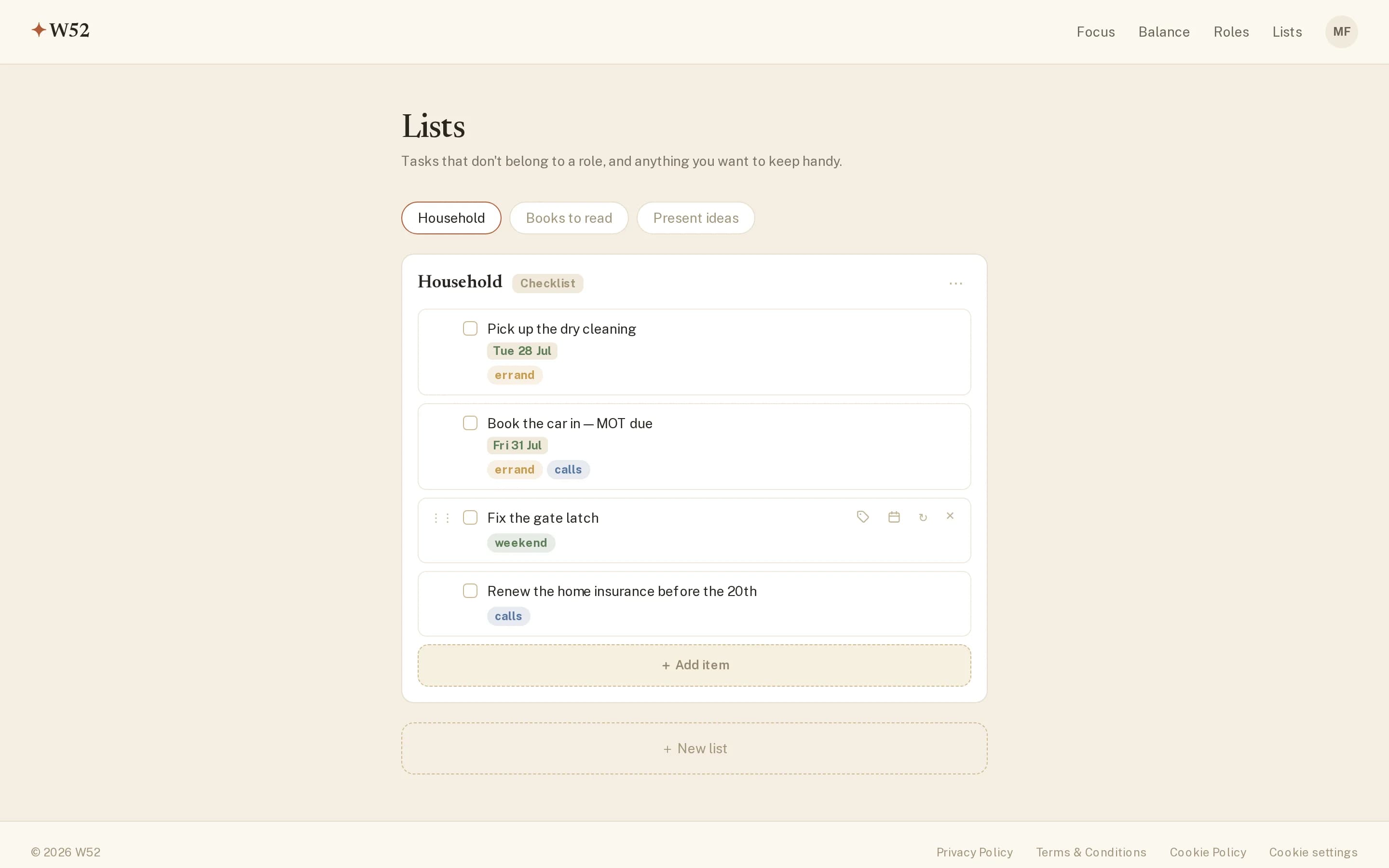
Two kinds of list
- Checklists are for things that get done — household jobs, packing, errands. Items tick off and fall away.
- Reference lists are for things that get kept — books to read, restaurants to try, present ideas. No checkboxes, no pressure, just a tidy shelf.
Tags, dates and repeats
Each list has its own small palette of tags — errand, calls, weekend — for slicing a long list by the mood or the moment (“what can I knock out while I’m in town?”). Give an item a date — and a time, if it has one — and it surfaces on that day across Focus and the planner, where it can be moved between days as the week shifts; recurring chores can repeat on a schedule, materialising each week by themselves. A repeat stays a single row on the list however many days it fills — the list is where you manage the pattern, and Focus is where you tick off a particular day. Removing one asks what you meant: just that day, keep the item but stop the pattern, or delete the repeat outright. A long checklist can also be sorted by date from its menu, so the dated items lead.
Deliberately outside the score
List items never count toward your week’s balance, even when they’re dated. That’s a feature: the score measures how you showed up for your roles, and a heroic week of errands shouldn’t be able to impersonate one.
With the week planned and the rest parked, one question remains: how did it go? On to reviews and Balance.